Monday, December 13, 2010

How to Making Cold Brewed Coffee


A hot coffee is more popular, but there is also cold-brewing. Making cold-brewed coffee is however more time consuming.
A hot cup of coffee is very common. Hot coffee warms up the stomach in the morning and rejuvenates a person, making him ready to start the day. People got so used to coffee being hot that they thought it could not be otherwise. However, many others wonder of the taste and feel of cold brewed coffee.

But truth to tell, cold coffee is as good as hot coffee. It can also give the same desired caffeine kick in your system.
Many believe that cold brewing is never possible. This is because brewing coffee requires the right amount of heat, such as in an espresso. Applying heat to coffee is fast brewing. It means the coffee flavors are extracted quickly. However, it is not really necessary. You can always advance your brewing so you can also brew it cold.
Cold brewing takes more time because it can only dissolve through certain elements of coffee grounds. About 90% of its flavor elements as well as its usual caffeine content would go through with this. Then, about 15% of its acids and oils will follow. Hence, this can change your coffee's taste but it will only concentrate on the most volatile flavor elements, making superbly flavored coffee.
Although it will be twice the strength, it will still possess lesser acidity and bite. So, for those who are into the "bite & acid" of coffee, cold brewing is not recommended.
In preparing cold brew, coffee beans must be hot-brewed first. Here's a basic procedure of making cold brew.
Ingredients (Good for 2 to 3 glasses):
Tall glass or mason jar w/ lid for brewing
Container (bottle, pitcher, small carafe or tall jar w/ lid) for the last brew that will be placed inside the fridge.
Second glass for the "steeped" coffee mixture
Kitchen Strainer (stainless steel) or cheesecloth
Procedure:
1. Measure about ¼ up to 1/3 cup of good coffee into your brewing glass.
2. Add 1 ½ cup of water (room-temperature, filtered or bottled water).
3. Stir the mixture. Make sure it is evenly stirred and free from lumps.
4. In order to keep your mixture clean, put a lid on top of your container. You can also use the canister type of container.
5. Allow it to sit for 3 to 12 hours.
6. After this, place the mixture onto the strainer, then, into the 2nd container.
7. Clean-up your 1st glass and have all the grounds inside rinsed out.
8. Pour the coffee from the 2nd glass back into the 1st glass, using the cheesecloth or finer mesh. This will remove all the fine grinds.
9. Pour your final mixture onto the storage container.
10. Place this inside the fridge.
Although you can not be strictly precise in measurements, you will be able to make the perfect tasting coffee if you keep the water to coffee ratio at 4:1.
The mixture can be approximately 2 to 3 times the strength. You can dilute it with equal amounts of water. Then serve with some ice. If your mixture is too strong, just add some water to dilute. Serve with sugar and cream.

Wednesday, December 8, 2010

How Much Coffee Caffeine In Your Cup?

Coffee is a complex mixture of chemical components of the coffee bean. Some of these components are partially destroyed by the roasting process; however, many of these components are not. Caffeine is one of the components that is not affected by the roasting process. With the addition of hot water, the caffeine is extracted from the coffee bean.
  
Caffeine was discovered in coffee in 1820. Caffeine is an alkaloid that acts as a mild stimulant. It increases the blood pressure, stimulates the central nervous system and the action of the heart and lungs, and promotes urine formation. It also acts as a diuretic and delays fatigue. Caffeine does have some positive side effects. It has been found to help treat migraines since it helps constrict the dilated blood vessels, therefore reducing the pain. It also has been documented to increase the potency of aspirin and to slightly relieve the affects of asthma attacks. It has been suggested that caffeine has been linked to possible cancers and birth defects. However, this has not been confirmed and there are no bans or warnings that have been issued by the US Food and Drug Administration (US FDA).

The amount of caffeine found in the coffee beans varies. On average, a regular cup of coffee contains approximately 90 to 150 mg of caffeine. Coffee brewed in a drip coffee maker has about 115 to 175 mg of caffeine while other coffee makers may brew coffee with about 80 to 135 mg. Typically, espresso has about as much caffeine as a regular cup of coffee. On average, a standard espresso cup would have about 100 mg of caffeine. However, the serving size for espresso is much smaller. The actual content of caffeine per milliliter in an espresso is much higher than in a regular brew. Also, caffeine is assimilated quicker when ingested in a concentrated dosage such as an espresso cup.

The amount of caffeine found in coffee blends will also vary. The following are examples of the caffeine content for different coffee blends:
-Brazilian Bourbons: contains 1.20% caffeine
-Columbia Excelso: contains 1.34% caffeine
-Columbia Supremo: contains 1.34% caffeine
-French Roast: contains 1.22% caffeine
-Costa Rican Tarrazu: contains 1.35% caffeine
-Vienna Roast: contains 1.27% caffeine
-Decafs: contains 0.02% caffeine

 
People hypersensitive to the caffeine found in coffee may decide to drink decaffeinated coffee. This way, they can still enjoy the great coffee taste, yet avoid the caffeine. Coffee can be "decaffeinated" by treating the green beans with solvents called chlorinated hydrocarbons. Once the solvents are removed, the beans are then roasted by ordinary procedures. Most people become accustomed to decaffeinated coffee and do not have to worry about the effects of caffeine.

Sunday, November 7, 2010

Things to know before buying a Nespresso coffee machine

Nespresso arrived with market power. It is the world leader in the burgeoning coffee single doses. His system is almost perfect.

The coffee is of high quality and capsule system is magnificent. The coffee is already ground and pressed into the capsule. The capsule has a filter. The coffee makers have the cachet of brands like Krups, DeLonghi and Siemens.
In almost all machines, making coffee is automatic, and the expulsion of the capsule takes place automatically.


Do we know something of its disadvantages?Have we thought about what are the problems of coffee Nespreso?. Analyze some of its drawbacks.


1.Prix capsules.


The capsules Nespreso system is very good. It prepares an espresso effortlessly. The coffee is already ground, pressed, metered and mixed to ensure a perfect espresso. But how much does each capsule?
Is it expensive? Is it cheap? It depends how we look.
The price of the cap is 0.3 cents. It's not a lot if we have coffee per day. If we take 10 per day, the amount will rise à3euros per day, and 60 per mois.Ce is not much if we compare it with shops.
But if we compare it with the price it costs us to prepare ourselves, with a bag of ground coffee, the difference is more noticeable.


2. The purchase of Nespresso capsules.


The coffee makers Nespreso bought at any location. It's very easy to buy coffee machines. The purchase is separate capsules. Access is very limited.
If you live in a big city, you can go directly into a Nespresso shop.Normally they are located downtown, yet that reaching them is complicated because it is difficult to park. Those who do not live in big cities, have necessarily to apply them on-line.


3.Entretien machines.


The coffee capsule require maintenance much lighter than coffee conventionnelles.Même expression if they get damaged.
The problem of Nespresso coffee makers is to find a technique similar service.Nespresso coffee fix is not complicated, but we do not always know how.

Friday, November 5, 2010

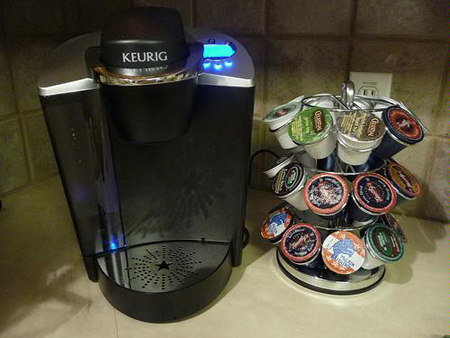
Comparing the Keurig K Cup Coffee Maker Models


The popularity of K Cup coffee makers has sparked a new interest in home coffee brewing around the world. As people discover this great new way of making coffee, they naturally have questions about what models are the best to buy. I will be reviewing several different models, but in this article I take a look at three of the Keurig models to provide you with an idea of the differences between them.

Keurig invented the K Cup idea, so it is natural that they have some of the best and most popular brewers on the market today. Among them are the Mini B30, the Elite B40, and the Platinum B70. I describe how the K Cup coffee maker works in general in another article on this topic, and these three models use the same basic technology to accomplish the task of brewing a cup of coffee. The significant difference between the low and the high end are speed of brewing, and water capacity.

The Mini B30 was designed for those who do not want a coffee maker to take up a bunch of counter space. While the B40 and B70 both have large water reservoirs, the B30 has none. With the B30, you press a button on the top to open the "jaws" of the brewer to insert your K Cup (the B30 only takes the 8 oz cup size). After inserting your favorite blend, you close the lid and the door for the water reservoir opens. At this point you fill the reservoir with 8 ounces of water, close the lid and wait about 3 minutes for the element to heat the water and pump out a hot cup of coffee. By eliminating the larger water reservoir the B30 definitely takes up less space, but at the cost of a bit longer wait time for a cup of coffee. It is designed very well, is attractive, and fits nicely in just about any nook in your kitchen.


The B40 and B70 are very similar in design. The only significant difference between these two models is capacity. The idea of the water reservoir is to provide faster brewing times. With pre-heated water in the tank, it only takes about 30 seconds to brew a cup of coffee. The B40 has a 48 oz. reservoir, and the B70 has a 60 oz. reservoir. In the time it takes the B30 to brew a single cup, you could pump at least 5 cups out on either of these models. The other advantage of the larger models is the ability to brew varying amounts of water. The B40 can brew 8 and 10 oz. cups while the B70 can brew 6, 8, 10, and 12 oz. cups.

For the coffee-lover who likes the ability to program the brewer functions, the B70 offers the greatest number of automation features. While the B30 is essentially a manual personal brewer, the B40 has an "auto-off" feature, and the B70 is programmable with auto-on, auto-off, and adjustable water temperature.


Wednesday, October 27, 2010

A Popular Kind of Coffee Machine

The CEO of Starbucks in 2008 made a business decision buy and exclusively use all future clover coffee makers be used only by Starbucks. This decision was because the Seattle based company wanted to sell the best coffee they can make. Why did they choose these makers over the standard maker?

The clover coffee machine worth around $11, 000 then can brew up one coffee at a time using freshly grounded beans. It uses a system known as the proportional integral derivative controller. This system allows you to put any amount of water, set-up the brewing time, and control the temperature of the water. This system allows the Starbucks and the manufacturers of the clover to create the best grounded coffee of your liking. The clover uses a technology called French presses and vacuum pots methods in today modern technology it is known as the Vacuum press technology.

Despite having buttons in order to operate this coffee maker you need to have a barista that can guide you. If a customer orders a cup of clover coffee the barista shall give the customer a selection of coffee beans to pick from. He/she will also ask the size of the cup after which he/she will measure the coffee beans and put them to a grinder to grind them. The grounded coffee is then poured into a brewer behind the brewer is a water boiler. The barista then mixes it to ensure the grounded coffee bean is moistened.

Once the coffee brew is ready the barista then places a cup into a plug, and press three buttons respectively respectively the button that controls the amount of water, the button that controls the temperature and the button used to adjust the brewing time. The brewing process occurs in a steel brew cylinder that is located on top of the piston which rises and falls. During the process of brewing the coffee the cylinder moves up and down as the grounded coffee are sent up and is sent out through some valves. The brewing process of a clover coffee maker usuall takes 30 - 4o seconds.

Coffee experts say that the famous coffee store starbucks uses roasted coffee beans also known as the French and Italian roast. But in a coffee taste done after the purchase of the rights of the clover coffee makers the use of dark roast such as aged Sumatra, Kenya nyeri mathira and shakisso to name a few all tasted bitter proving that the machine or coffee maker cannot make bad coffee into good coffee.

If you use in your maker the Columbian narino supremo and Guatemalan Antigua it will make the coffee taste like brewed java that has been in a French press. The significant difference is the time it takes to brew using French press is around 10 minutes and the use of clover maker takes only a minute.

What Is the Best Thermal Coffee Maker?

When we strive to find out who makes the best coffee maker, we need to take into consideration the type of coffee machine, whether it be a drip, French press or single cup... and then compare how good the coffee tastes an hour after you have brewed it. Let's explore only the drip machines for now.
Many automatic drip coffee makers perform very well, but if you are like me, and want to return to grab another cup of coffee an hour or so after the first... it's important to have a thermal coffee maker.

Why does it matter if choose to use a thermal carafe?
The basic drip brewing system that most of us have in our homes utilizes a technique that heats up your water to the optimal temperature for extracting the best flavor from your coffee, and then slowly drips the heated water over your ground beans and releases the newly brewed coffee into a carafe.
The typical carafes are constructed of glass, and generally sit on a heat plate to keep the coffee hot.
What happens when your coffee sits on a burner for more than 10 minutes is devastating to the outcome of the brewed coffee. If you haven't tried tasting coffee from a thermal carafe, you are in for a real treat.

Why choose a thermal coffee maker?
When you realize that the best tasting drip coffee is brewed into a thermal carafe, the choices you have when selecting a coffee maker are substantially narrowed down to the top few manufacturers. Cuisinart, Black and Decker and Zojirushi coffee makers, just to name a few of the better buys.
I bet you have noticed that all the best coffee houses, such as Starbucks, use thermal containers to store the recently brewed coffee. There is just cause for this!

How do you select the best thermal coffee maker?
To find out which is the best coffee maker thermal style is as easy to find as browsing these few considerations:
  1. Decide if you need a coffee machine to drip 12 cups, 10 cups or maybe just a cup or two at a time. You can find thermal pots in a variety of sizes.
  2. If you have a shortage of counter space, you should consider the smaller machine.
 It's best to read all the reviews you can to see what others are talking about. Some machines are more complicated to use, and it feels like you need a whole day just to go over the manual. Others perform very simply, like the Zojirushi fresh brew, and you can usually get your first cup nearly as quick as you can unpack your new coffee maker.

Additionally, many manufacturers offer a water filter... and some manufacturers include a water filter (included with your purchase). After all, it's the quality of the water that will determine the final taste of your coffee. You will save money if the coffee maker has a water filter included with your purchase, and you will know that it's the right size for that machine.
Notice where the controls are located, and if they are lit at nighttime. It's not fun to fumble around with a coffee maker full of water. A backlit clock is nice, and it's easy to see when it's dark or early in the morning when most of us use our machines.

Filter baskets... What is the best choice?
Basically there are 2 shapes to coffee filter baskets, flat bottomed and cone shaped. The difference between the two is nominal, but you should know that a cone shaped filter basket would generally use less ground coffee than the flat-bottomed shape.
This is because the filter basket is wider at the top, filtering the hot water through the grounds to the pointed end at the bottom, assuring that all the grounds are uniformly wet. A flat-bottomed filter basket needs to have a good "sprinkler" type of drip machine to equal this, and since the basket is wider, it will use a bit more coffee.

Other options to consider
Typically, thermal coffee makers drip the brewed coffee into a thermal carafe. But, you will find some coffee-on-demand type of coffee machines that use an insulated reservoir to hold your coffee and keep it hot.
The problem with many of the coffee on demand types are that the reservoirs are constructed of plastic, and they use a heating element in the reservoir to keep your coffee up to acceptable temperature. This sometimes leads to plastic tasting coffee.

The idea is good, but I have yet to find one that uses a thermal carafe to hold the coffee and keep it hot for hours like the best thermal coffee maker can.

Getting the Best Coffee Makers at Sale Prices

coffee makers a a superb idea for the home, and many of the best are currently available at sale prices. There really aren't enough hours in the day to brew that ideal cup of coffee right now. Instant is nice, but sometimes it just doesn't cut it in terms of quality or flavour. Thankfully, there are some marvellous coffee makers on the market that can help you enjoy premium grade coffee at home at a fraction of the price of a cafe.

Well designed and excellent for brewing the perfect coffee for yourself and guests (they're great for when you have a dinner party or friends over), a coffee maker can help cut stress and the hassle of making it yourself with push-button use and surfaces that are easy to clean and maintain.

You can easily make all of your favourite hot drinks from the coffee house lifestyle that is so much in demand right now, and you can make sure that each cup turns out just how you like it. There are models available to suit every kitchen and every taste, from a selection of the most well respected manufacturers in the home goods industry.

Thanks to the regular seasonal glut of coffee makers that have been made available, many retailers both in stores and online are offering them at discounted prices, meaning the coffee consumer is able to bag a bargain.

Taking advantage of the sales and discounts available right now is a superb way to live the lifestyle you want while keeping within a strict budget. Quality doesn't have to break the bank, and with the best coffee makers available at low prices right now, you can enjoy the cafe lifestyle without having to constantly pay cafe prices.